





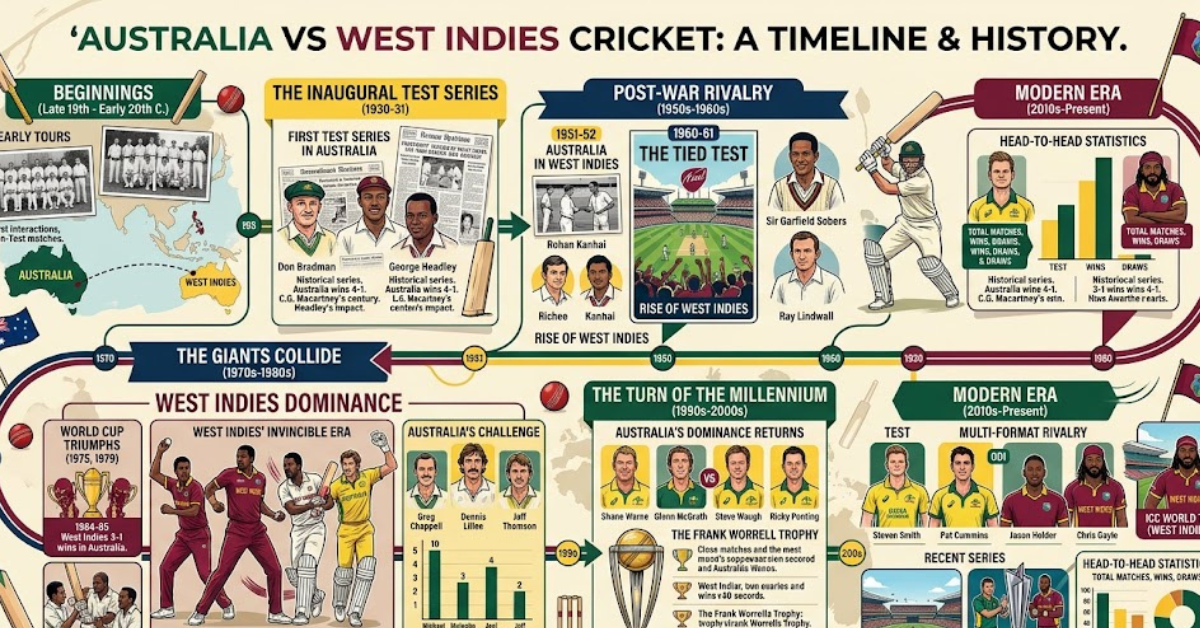

The west indies cricket team vs australian men’s cricket team timeline is one of the most fascinating stories in international cricket history. It’s a rivalry filled with dominance shifts, legendary players, unforgettable series, and moments that shaped modern cricket.
The focus keyword west indies cricket team vs australian men’s cricket team timeline reflects a long-standing contest between two cricketing giants—Australia, known for discipline and structure, and the West Indies, famous for flair and explosive talent.
In this article, we’ll walk through the timeline of their rivalry, highlight iconic matches, and revisit the players who made this clash so memorable.
Early Encounters: 1930s–1950s
The rivalry began in the early days of Test cricket.
Key early facts:
- First Test series played in 1930
- West Indies were still developing as a Test nation
- Australia dominated early encounters
During this period, Australia’s experience and structure gave them a clear advantage, but the West Indies were slowly building confidence.
Rise of West Indies Cricket: 1960s–1970s
The west indies cricket team vs australian men’s cricket team timeline became more competitive during this era.
Major developments:
- West Indies improved their fast-bowling attack
- Emergence of aggressive batting style
- First signs of rivalry intensity
Key highlight:
- 1960–61 series in Australia ended 2–1 in Australia’s favor, but West Indies showed serious fight
This period marked the beginning of a more balanced contest.
West Indies Dominance Era: 1980s
The 1980s is often called the golden age of West Indies cricket.
What happened:
- West Indies became world champions in style
- Fast bowlers dominated world cricket
- Australia struggled against their pace attack
Famous players:
- Viv Richards
- Malcolm Marshall
- Clive Lloyd
During this phase, West Indies often outplayed Australia in both Test and ODI formats.
Australia’s Comeback: 1990s
The west indies cricket team vs australian men’s cricket team timeline shifted again in the 1990s.
Key changes:
- Australia rebuilt a strong squad
- Rise of players like Shane Warne and Glenn McGrath
- West Indies began losing consistency
Important moment:
- Australia started dominating Test series again
- West Indies struggled to maintain their earlier dominance
This decade marked a major turning point.
Australia’s Golden Era: 2000–2010
This period saw Australia become the strongest team in world cricket.
Highlights:
- Multiple Ashes and World Cup victories
- Strong batting lineup with Ponting and Hayden
- Dominant bowling attack
Against West Indies:
- Australia won most series comfortably
- West Indies were rebuilding their squad
The rivalry became one-sided during this era.
Modern Era: 2010–Present
In recent years, the west indies cricket team vs australian men’s cricket team timeline has seen occasional surprises.
Key points:
- West Indies improved in T20 format
- Australia remains dominant in Tests
- Matches are more competitive in shorter formats
Notable moments:
- West Indies T20 victories against Australia
- Emergence of players like Chris Gayle and Andre Russell
- Australia maintaining Test superiority
The rivalry today is more balanced in T20s but still Australia-dominated in Tests.
Head-to-Head Overview
Across formats, the rivalry shows clear trends:
Test cricket:
- Australia has historically dominated
- Strong home advantage plays a key role
ODIs:
- Australia leads overall
- West Indies had strong spells in the 1970s–1980s
T20s:
- More balanced competition
- West Indies slightly stronger in explosive formats historically
Legendary Players in the Rivalry
Australia:
- Ricky Ponting
- Steve Waugh
- Shane Warne
- Glenn McGrath
West Indies:
- Sir Vivian Richards
- Brian Lara
- Curtly Ambrose
- Chris Gayle
These players shaped the identity of the rivalry.
Why This Rivalry Matters
The west indies cricket team vs australian men’s cricket team timeline is important because:
- It reflects changing eras of cricket dominance
- It showcases evolution in playing styles
- It highlights legendary cricket personalities
- It represents cultural cricket contrasts
Australia represents structure and discipline, while West Indies represents flair and aggression.
Key Turning Points in the Timeline
Major shifts:
- 1930s–1950s: Australia dominance
- 1980s: West Indies peak era
- 1990s: Australia comeback
- 2000s: Australian global dominance
- 2010s–present: Mixed competitive phase
Each phase tells a different story of cricket evolution.
FAQs on West Indies vs Australia Cricket Timeline
1. What is the west indies cricket team vs australian mens cricket team timeline?
It is the historical record of matches and performances between Australia and West Indies in international cricket.
2. Which team has won more matches?
Australia has won more matches overall, especially in Test cricket.
3. When was West Indies most dominant?
West Indies were most dominant during the 1980s.
4. Is the rivalry still strong today?
Yes, especially in T20 cricket where matches are more competitive.
5. Who are the greatest players in this rivalry?
Viv Richards, Brian Lara, Ricky Ponting, and Shane Warne are among the most iconic.
Conclusion
The west indies cricket team vs australian mens cricket team timeline is a story of shifting power, legendary performances, and unforgettable cricket history. From Australia’s early dominance to West Indies’ golden era and Australia’s modern-day strength, this rivalry has seen every possible twist.
Today, while Australia remains stronger in longer formats, West Indies continue to shine in shorter formats, keeping the rivalry alive and exciting.
If you enjoy cricket history, this matchup is one of the best examples of how the game evolves across generations.