





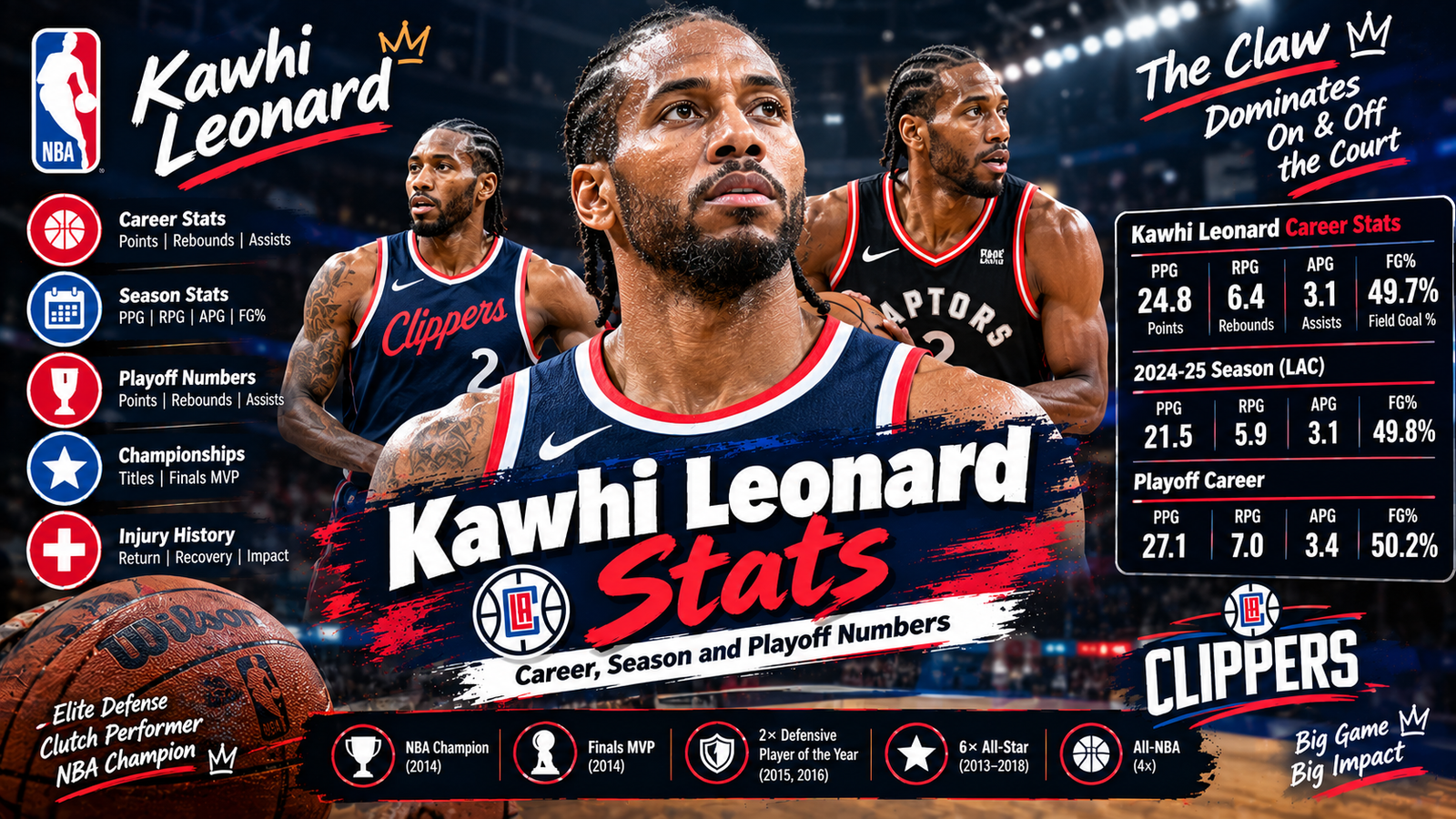

Kawhi Leonard Stats is one of the most accomplished two-way players in modern NBA history. Known for his exceptional defense, efficient scoring, strong mid-range game, and calm style of play, Leonard has built an impressive statistical record throughout his NBA career. From his early years with the San Antonio Spurs to championship runs with the Toronto Raptors and Los Angeles Clippers, Kawhi Leonard stats provide a clear picture of his impact on both ends of the court.
Whether you are looking for his career averages, scoring numbers, playoff statistics, or individual achievements, this guide covers the major statistical categories associated with Kawhi Leonard.
Kawhi Leonard Career Stats
Kawhi Leonard entered the NBA in 2011 after being selected by the San Antonio Spurs. Over the years, his role developed from a defense-first forward into a primary scoring option and franchise player.
His career statistics include production across several major categories:
- Points: Leonard has developed into a high-level scorer, regularly averaging more than 20 points per game during his prime seasons.
- Rebounds: His combination of size, strength, and positioning makes him an effective rebounder from the small forward and power forward positions.
- Assists: Leonard has gradually improved as a playmaker, particularly as his offensive responsibilities have increased.
- Steals: Defensive instincts have always been a major part of his game, with steals contributing to his reputation as an elite perimeter defender.
- Field-goal percentage: Leonard has generally maintained strong shooting efficiency while taking difficult shots and carrying significant offensive responsibilities.
- Three-point shooting: His three-point shooting has become an important part of his offensive game, especially during his years as a primary scorer.
His overall numbers reflect a player who contributes in multiple statistical categories rather than relying exclusively on scoring.
Kawhi Leonard Points Per Game
Scoring is one of the most important parts of Leonard’s statistical profile. Early in his career, he primarily scored through transition opportunities, cuts, spot-up shooting, and efficient finishing around the basket.
As his role expanded, Leonard became a much more complete offensive player. He developed a reliable mid-range jumper, improved his three-point shooting, and became highly effective in isolation situations.
During his peak seasons, Leonard produced scoring averages in the mid-20s, demonstrating his ability to serve as a team’s primary offensive option. His scoring efficiency is particularly notable because he can create his own shot while also converting difficult attempts against strong defensive coverage.
Leonard’s scoring statistics also show how his offensive game evolved. Rather than depending entirely on athleticism, he uses strength, footwork, shooting ability, and controlled movement to create scoring opportunities.
Kawhi Leonard Rebounding Stats
Although Leonard is primarily known for scoring and defense, rebounding is another important part of his statistical contribution.
His size and physical strength allow him to compete effectively against opposing forwards and guards. Leonard has posted several seasons with strong rebounding averages, especially when playing significant minutes at forward.
Offensive rebounds can create additional scoring opportunities, while defensive rebounds allow his team to end possessions and begin transition attacks.
His rebounding numbers are particularly valuable because they come from a player who also carries a large offensive workload. Leonard does not need to sacrifice his scoring responsibilities to contribute on the glass.
Kawhi Leonard Assist Stats
Leonard’s assist numbers have increased as his role has changed throughout his career.
When he played primarily as a complementary offensive player in San Antonio, Leonard did not need to handle the ball on every possession. Later, with Toronto and the Clippers, he became more involved in pick-and-roll situations, isolation possessions, and half-court playmaking.
While Leonard has never been primarily a pass-first point guard, his ability to draw defensive attention creates opportunities for teammates. His assist statistics therefore represent another part of his development from a role player into a complete offensive centerpiece.
Kawhi Leonard Defensive Stats
Defense remains one of the defining features of Kawhi Leonard’s career.
His defensive statistics include steals, defensive rebounds, and other measurable contributions, but traditional box-score numbers do not fully capture his defensive impact.
Leonard became famous for his strong hands and ability to defend multiple perimeter positions. His large hands and excellent positioning helped him disrupt passing lanes and pressure ball handlers.
He won the NBA Defensive Player of the Year Award twice during his career and was selected to multiple All-Defensive teams.
His defensive reputation was established early with San Antonio, where he developed into one of the league’s most respected perimeter defenders.
Kawhi Leonard Playoff Stats
Leonard’s playoff statistics are an important part of his legacy.
Unlike regular-season statistics, playoff numbers come against teams competing under significantly higher pressure. Leonard has produced several outstanding postseason performances during championship runs.
His most famous playoff campaign came in 2019 with the Toronto Raptors. During that postseason, Leonard was the team’s leading offensive player and helped Toronto win its first NBA championship.
He averaged more than 30 points per game during the 2019 postseason and delivered several memorable performances, including a dramatic series-winning shot against the Philadelphia 76ers.
Leonard has also recorded strong playoff numbers with the Spurs and Clippers, demonstrating his ability to score efficiently and defend at a high level during postseason competition.
Kawhi Leonard NBA Championships
Leonard has won two NBA championships with two different franchises.
His first championship came with the San Antonio Spurs in 2014. Leonard played a major role in the Finals against the Miami Heat and was named NBA Finals MVP.
His second championship came with the Toronto Raptors in 2019. Leonard again won the Finals MVP award, making him one of the few players to win the award with multiple franchises.
These accomplishments are an important part of understanding Kawhi Leonard’s statistics because his production has repeatedly translated into postseason success.
Kawhi Leonard Awards and Achievements
Beyond his statistical averages, Leonard has collected numerous individual honors.
Some of his most notable achievements include:
- Two-time NBA champion
- Two-time NBA Finals MVP
- Two-time NBA Defensive Player of the Year
- Multiple-time NBA All-Star
- Multiple All-NBA selections
- Multiple NBA All-Defensive Team selections
- NBA All-Rookie First Team
- NBA steals leader in 2015–16
- 2014–15 All-Defensive First Team selection
These awards highlight the unusual combination of offensive and defensive ability represented in his statistics.
Kawhi Leonard Career Highs
Leonard has produced several impressive individual statistical performances throughout his career.
His career highs include major scoring performances as well as games with significant totals in rebounds, assists, steals, and other categories. His ability to impact games without relying solely on scoring is one reason his statistical profile is so diverse.
One of the most memorable performances of his career came during the 2019 playoffs, when he scored 45 points against the Philadelphia 76ers in Game 1 of their Eastern Conference semifinal series.
His postseason performances have also included numerous 30-point games and several games in which he contributed heavily in multiple statistical categories.
Why Kawhi Leonard Stats Matter
Looking at Kawhi Leonard’s statistics as a whole provides a better understanding of his career than focusing on one category.
His scoring numbers show how he developed into an elite offensive player. His rebounding and assist statistics demonstrate his all-around contributions, while his steals and defensive honors reflect his impact on the defensive end.
Perhaps most importantly, Leonard’s playoff statistics demonstrate his ability to perform in high-pressure situations. His two Finals MVP awards, two championships, and extensive postseason production are major parts of his statistical legacy.
Final Thoughts on Kawhi Leonard Stats
Kawhi Leonard stats tell the story of a player who evolved significantly throughout his NBA career. He entered the league as a defense-focused forward and gradually became an elite scorer, playmaker, and complete two-way star.
His career includes strong regular-season production, impressive playoff performances, two NBA championships, and major individual awards. While traditional statistics cannot capture every aspect of his defensive impact, his points, rebounds, assists, steals, shooting efficiency, and playoff production demonstrate why Leonard has been regarded as one of the NBA’s premier two-way players.
For anyone researching Kawhi Leonard, comparing his regular-season numbers with his playoff statistics offers the clearest picture of his development and overall impact on the game.