





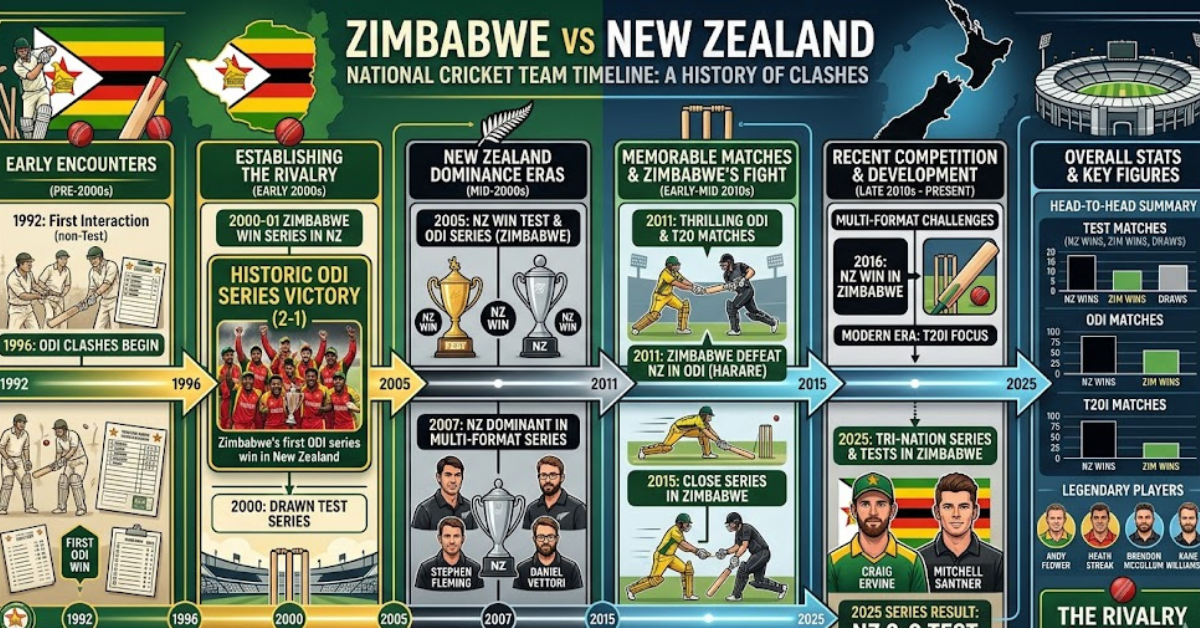

The zimbabwe national cricket team vs new zealand national cricket team timeline is a fascinating journey through international cricket history, showing the contrast between a rising African cricket nation and a consistent, world-class team from New Zealand.
The focus keyword zimbabwe national cricket team vs new zealand national cricket team timeline highlights a rivalry that has mostly been dominated by New Zealand but still includes important moments of growth, resilience, and competitive spirit from Zimbabwe.
In this article, we’ll break down the full timeline of their matches, key performances, and how both teams evolved across different eras of cricket.
Early Encounters: 1990s Beginnings
The rivalry began after Zimbabwe became a full ICC Test nation in 1992.
Key early facts:
- First official Test series played in the early 1990s
- New Zealand already had established international experience
- Zimbabwe was still building its cricket structure
Early pattern:
New Zealand dominated most early encounters, but Zimbabwe showed flashes of talent, especially in home conditions.
1992–1999: New Zealand Establishes Control
During this period, the zimbabwe national cricket team vs new zealand national cricket team timeline was heavily one-sided.
Key highlights:
- New Zealand won most Test and ODI series
- Zimbabwe struggled with consistency
- Zimbabwe’s batting lineup began to develop key players
Important trend:
Despite losses, Zimbabwe gained valuable experience playing against stronger opposition.
2000–2005: Zimbabwe’s Competitive Phase
This was one of Zimbabwe’s more competitive eras.
What changed:
- Zimbabwe produced strong players like Andy Flower and Heath Streak
- Team performance improved in ODIs
- New Zealand still maintained overall dominance
Key moment:
Zimbabwe managed to push New Zealand harder in both formats, especially in home conditions.
2005–2010: Zimbabwe’s Transitional Struggles
The mid-2000s were challenging for Zimbabwe cricket.
Key issues:
- Player retirements and political instability affected cricket
- Team rankings dropped significantly
- New Zealand dominated most encounters
Match trend:
New Zealand often won comfortably during this phase.
2011–2015: Rebuilding Zimbabwe Cricket
This period marked Zimbabwe’s rebuilding phase.
Key developments:
- Return of experienced players
- Focus on youth development
- Improved performances in ICC events
Against New Zealand:
- New Zealand still held the upper hand
- Zimbabwe showed improved batting resilience
The gap between the teams began to narrow slightly.
2016–2019: Competitive but Uneven Matches
The zimbabwe national cricket team vs new zealand national cricket team timeline became more balanced in terms of effort, even if results still favored New Zealand.
Key points:
- Zimbabwe showed improved bowling attack
- New Zealand remained a top-tier global team
- ODI and T20 matches became more competitive
Notable trend:
Zimbabwe occasionally challenged New Zealand in shorter formats.
2020–Present: Modern Era of Cricket
In recent years, the rivalry has continued with New Zealand clearly ahead but Zimbabwe showing steady improvement.
Key developments:
- New Zealand became one of the world’s most consistent teams
- Zimbabwe improved young talent development
- ICC tournaments occasionally brought them together
Match pattern:
- New Zealand dominates Tests and ODIs
- T20 matches are slightly more competitive
Head-to-Head Overview
Across formats, the stats clearly show New Zealand’s dominance:
Test cricket:
- New Zealand leads comfortably
- Zimbabwe has struggled historically
ODIs:
- New Zealand holds a strong winning record
- Zimbabwe has occasional competitive performances
T20Is:
- New Zealand still leads
- Zimbabwe shows flashes of improvement
Key Players in the Rivalry
Zimbabwe:
- Andy Flower
- Heath Streak
- Brendan Taylor
- Sikandar Raza
New Zealand:
- Kane Williamson
- Brendon McCullum
- Ross Taylor
- Trent Boult
These players shaped the identity of their respective teams during key eras.
Why This Rivalry Matters
The zimbabwe national cricket team vs new zealand national cricket team timeline is important because:
- It reflects cricket development differences between nations
- It highlights Zimbabwe’s resilience in international cricket
- It shows New Zealand’s consistency as a top cricketing nation
- It provides learning experiences for emerging teams
Even though it is not a high-intensity rivalry, it carries historical and developmental significance.
Timeline Summary of Key Phases
1. Early Era (1992–1999)
- New Zealand dominance
- Zimbabwe enters Test cricket
2. Competitive Growth (2000–2004)
- Zimbabwe improves performance
- Stronger batting lineup
3. Decline Phase (2005–2010)
- Zimbabwe struggles
- New Zealand dominates
4. Rebuilding Phase (2011–2015)
- Youth development begins
- Slight performance improvement
5. Modern Era (2016–Present)
- New Zealand remains dominant
- Zimbabwe continues gradual progress
FAQs on Zimbabwe vs New Zealand Cricket Timeline
1. What is the zimbabwe cricket team vs new zealand cricket team timeline?
It is the history of matches and performances between Zimbabwe and New Zealand in international cricket.
2. Which team has won more matches?
New Zealand has won significantly more matches across all formats.
3. When did Zimbabwe first play New Zealand?
Their early official encounters began after Zimbabwe gained Test status in the early 1990s.
4. Has Zimbabwe ever beaten New Zealand?
Yes, Zimbabwe has recorded a few wins, especially in ODIs and home conditions.
5. Is the rivalry still active?
Yes, both teams continue to meet in ICC tournaments and bilateral series.
Conclusion
The zimbabwe national cricket team vs new zealand national cricket team timeline tells the story of experience versus development. New Zealand has consistently remained a strong and stable cricketing force, while Zimbabwe has shown determination, rebuilding phases, and moments of promise.
Although the rivalry is not evenly balanced in terms of results, it remains important in understanding how different cricket nations grow and compete on the global stage.
As Zimbabwe continues to develop and New Zealand maintains its elite standards, this timeline will keep evolving with new chapters in international cricket.